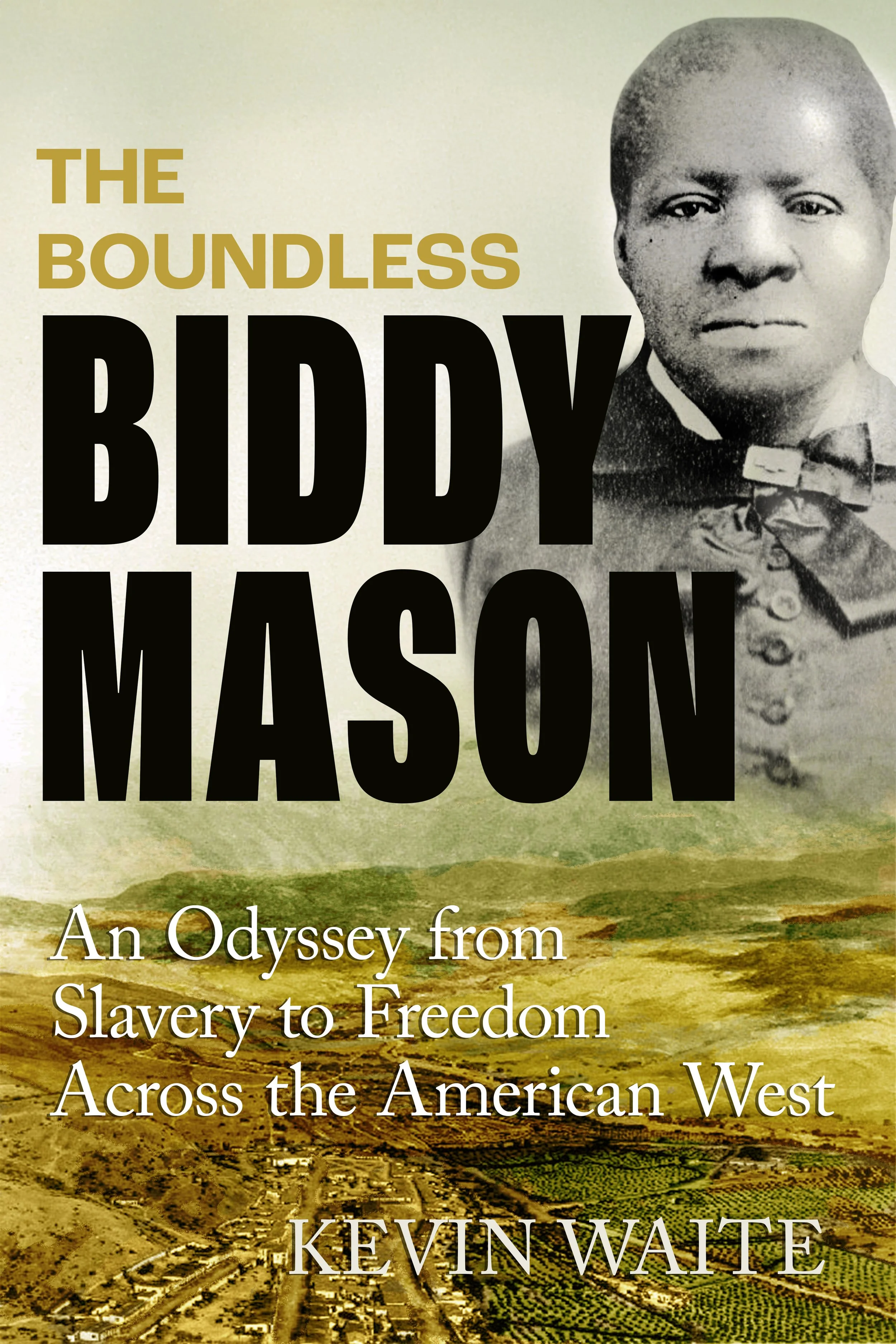
The Boundless Biddy Mason:
An Odyssey from Slavery to Freedom Across the American West
-
How Biddy Mason crossed the continent, broke free from slavery, and built Black Los Angeles.
Born in bondage, Biddy Mason endured one of the longest forced migrations in American history—three thousand miles on foot from Georgia to California. She and her daughters labored in slavery in the “free” state of California for five years before launching a landmark emancipation suit in 1856. Free at last, she defied barriers of race and gender, rising to prominence as a healer, philanthropist, church builder, and real estate entrepreneur whose commercial properties stood at what became known as the “Wall Street of the West.” By the time of her death in 1891, she had laid the foundations of Black Los Angeles and ranked among the richest women of color in the United States.
In this first book-length biography of Mason, prizewinning historian Kevin Waite uncovers an extraordinary story of survival that carries readers from the cotton South to metropolitan California, and through the Civil War, Reconstruction, and the dawn of Jim Crow. By retracing Mason’s odyssey, he illuminates both the continental sweep of American slavery and the fragile, hard-won possibilities of freedom in the West. -
“Absorbing and revelatory, this is history at its best.” (National Book Award-winner and perennial bestseller Nathaniel Philbrick)
“A tremendous achievement” (Frederick Douglass Book Prize-winner Manisha Sinha)
“The book we’ve needed for a long time” (Bancroft Prize-winner Kelly Lytle Hernandez)
“With great learning and beautiful writing, as well as remarkable detective work, Waite has enabled us to discover Biddy Mason.” (Pulitzer Prize-winner Steven Hahn)
-
“The Mother of Black Los Angeles Finally Gets Her Due,” Zocalo Public Square, September 17, 2026
“L.A. renames Pershing Square after Biddy Mason,” Los Angeles Times, September 4, 2026
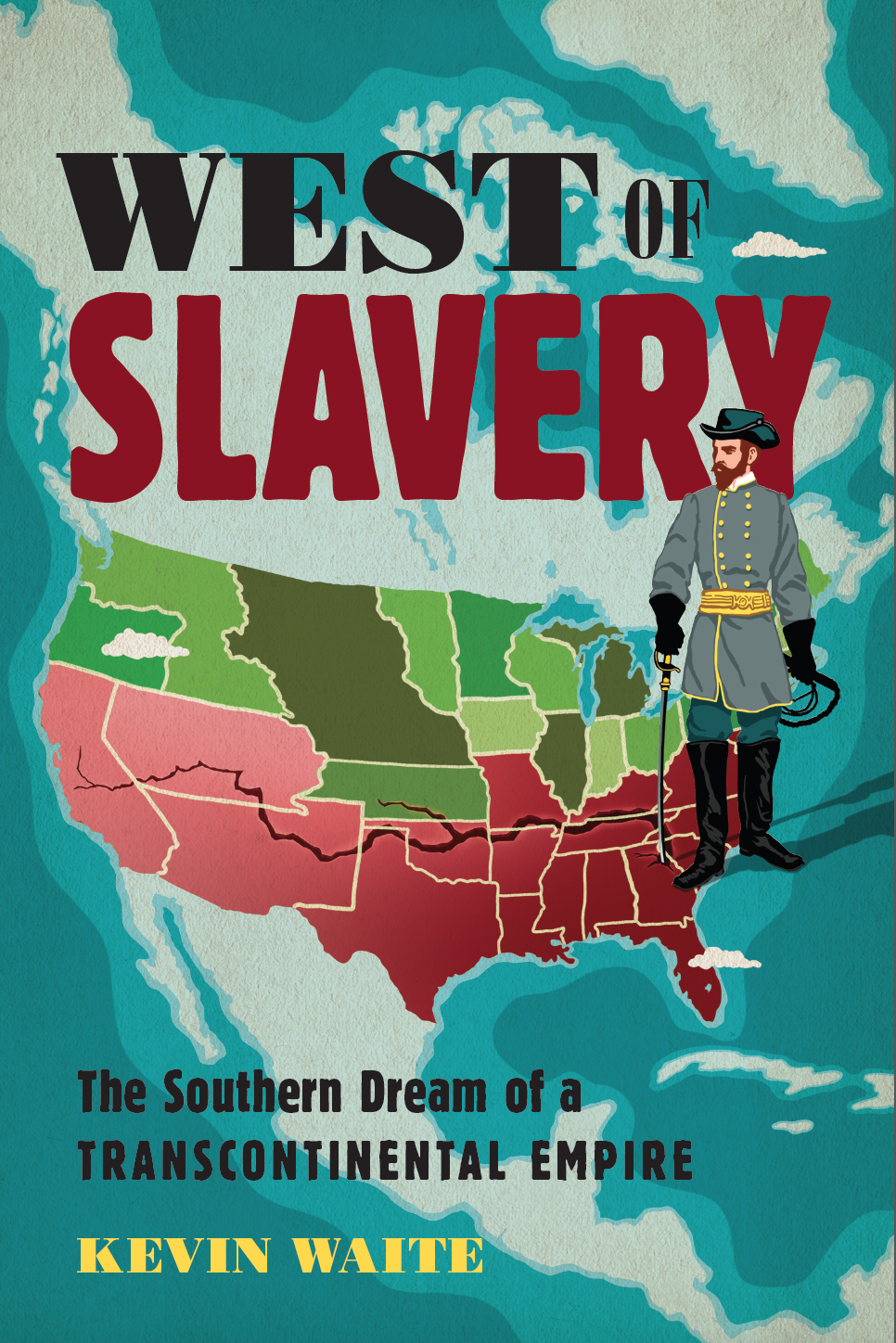
West of Slavery:
The Southern Dream of a Transcontinental Empire
-
How slaveholders and slavery spread across the continent in the Civil War era.
When American slaveholders looked west in the mid-nineteenth century, they saw an empire unfolding before them. They pursued that vision through diplomacy, migration, and armed conquest. By the late 1850s, slaveholders and their allies had transformed the southwestern quarter of the nation – California, New Mexico, Arizona, and parts of Utah – into a political client of the plantation states. Across this vast swath of the map, white southerners defended the institution of African American chattel slavery as well as systems of Native American bondage. This surprising history uncovers the Old South in unexpected places, far beyond the region’s cotton fields and sugar plantations.
Slaveholders' western ambitions culminated in a coast-to-coast crisis of the Union. By 1861, the rebellion in the South inspired a series of separatist movements in the Far West. Even after the collapse of the Confederacy, the threads connecting South and West held, undermining the radical promise of Reconstruction. Kevin Waite brings to light what contemporaries recognized but historians have described only in part: The struggle over slavery played out on a transcontinental stage. -
2022 Wiley-Silver Prize, Center for Civil War Research, University of Mississippi
Finalist, Lincoln Prize
Finalist, Paul E. Lovejoy Prize, Journal of Global Slavery
Finalist, SHEAR Manuscript Prize
“Five Best Books” ever written on the Civil War in the Far West - Civil War Monitor
“Eleven books that shaped how we think about California” - Boom: A Journal of California
-
“Sophisticated and deftly-written… West of Slavery will influence our understanding of slavery and the West for years to come.”—Wiley-Silver Prize Committee
“A conceptually ambitious, colorful, and engrossing read… it draws on prodigious original research.”—Robert E. May, American Historical Review
“In addition to its lucid writing and meticulous research this work stands out for its argument’s scope and nuance… This valuable, boundary-pushing book merits a prominent place on the shelves of scholars of politics, southern and western history, and Civil War and Reconstruction history.”—Journal of American History
“Waite provides vivid detail in this readable narrative, as well as abundant documentation of primary and secondary sources and helpful maps and illustrations. . . . Readers interested in the South and Confederacy will benefit from this fine work that broadens our understanding of this important era of American history.”—Library Journal
“Corrects oversights on Western slavery that are rooted in familiar mythology. . . . By showing how slavery was integral to the development of the Southwestern territories, Waite brings much-needed energy to the study of Western history, which has for too long regarded the region as special and alien to the controversies that divided the rest of the country. This is a critical contribution to our understanding of why slavery poisoned the whole nation and not merely a portion.”—Los Angeles Review of Books“A significant achievement of scholarship. . . . As the scholarship on the Civil War in the West continues to develop, West of Slavery should long stand as a critical intervention in the literature.”—Civil War Monitor
“This book makes an enormous contribution to our understanding of the coming of the Civil War—one that will change how we teach about the sectional crisis in the United States.”—Alice Baumgartner, H-Diplo
“West of Slavery is insightful, well researched, and a pleasure to read, making it accessible to scholars, students, and Civil War buffs alike.”—H-CivWar“Waite succeeds admirably in showing the arbitrariness of our con temporary historiographical divisions and how much can be gained by placing southern and western history in dialogue with one another.”—Karl Jacoby, Journal of the Early Republic
“An important entry into the study of the region during this critical nation-building period, Waite’s work reveals how the fight to ensure the continuation of slavery in the United States spread from coast to coast, providing an absorbing perspective on the road to civil war.”—Civil War History“Waite is a writer of unusual clarity, and his book is an accessible contribution to the new slavery historiography as well as the growing literature addressing linkages between free and unfree labor systems in the West… No writer has so forcefully elucidated why the slave South cast such a long shadow in the Far West.”—Pacific Historical Review
“An invaluable and stimulating contribution to the historiographies of both the Civil War and the American West.”—Journal of the Civil War Era
“West of Slavery recovers how a vast region dominated by scrupulous ruling elites, blessed by federal powerbrokers, and regulated by militant racial violence played critical roles in the sectional crises of the 1850s, the transnational aims of the slaveholding Confederacy, and the devastating white 'redemption' of the Reconstruction era. In spanning the entire Civil War era, Waite compels scholars to reconsider their prior assumptions.”—Andrew F. Lang, Missouri Historical Review“Marvelous… Perhaps the greatest strength of West of Slavery is Kevin Waite’s ability to restore contingency to the seemingly foregone conclusion that southern ambitions would fail. The author’s investigation into the seemingly stolid topic of western infrastructure reveals both the breadth of his vision and skill as a writer.”—Amy S. Greenberg, Civil War Book Review
“Kevin Waite is not only a determined scholar. He is also a wonderful writer.”—Boom California
“Readers may be shocked to learn that no other free state has more Confederate monuments than California. Waite’s map of their locations in the Epilogue would be a particularly effective teaching tool for historians of the West and Civil War memory. West of Slavery is engaging and convincing.”—Megan Kate Nelson, Southern California Quarterly
“Waite demonstrates that, from Thomas Jefferson on, the South had big plans for the West. . . . [This] enlightening book provides details of the Southern strategy to 'own' the West.”—Crosscut“The accessible quality of its arguments commends West of Slavery for use with undergraduates in U.S. and California history, and it offers tantalizing new territory to explore for those studying the nonlinear paths toward racial and social equity in the United States.”—California History
“A clear and energetic account that is eminently readable and teachable. It is a bold case for the importance of the West in up-to-date Civil War and Reconstruction histories, and for taking seriously the influence of slavery’s partisans in the U.S. West and beyond.”—Western Historical Quarterly“Waite’s impressive work promises to make a splash in the fields of Civil War history and Borderlands history.”—William S. Kiser, New Mexico Historical Review
Waite’s mapping of the white southern expansionist imagination and politico-cultural network is a significant achievement.”—Southwestern Historical Quarterly
“West of Slavery is, fundamentally, a broadening of horizons.”—Emerging Civil War
-
“The Southern Slaveholders Dreamed of a Slaveholding Empire,” Jacobin, September 21, 2021
“Slavery existed in California too, historian tells Redlands audience,” Southern California News Group, May 4, 2023
“Alumni gift creates first endowed history lecture with renowned speaker,” Texas A&M-San Antonio, January 30, 2026